Why Public Corruption Commentary Often Misses the Rot Beneath the Surface
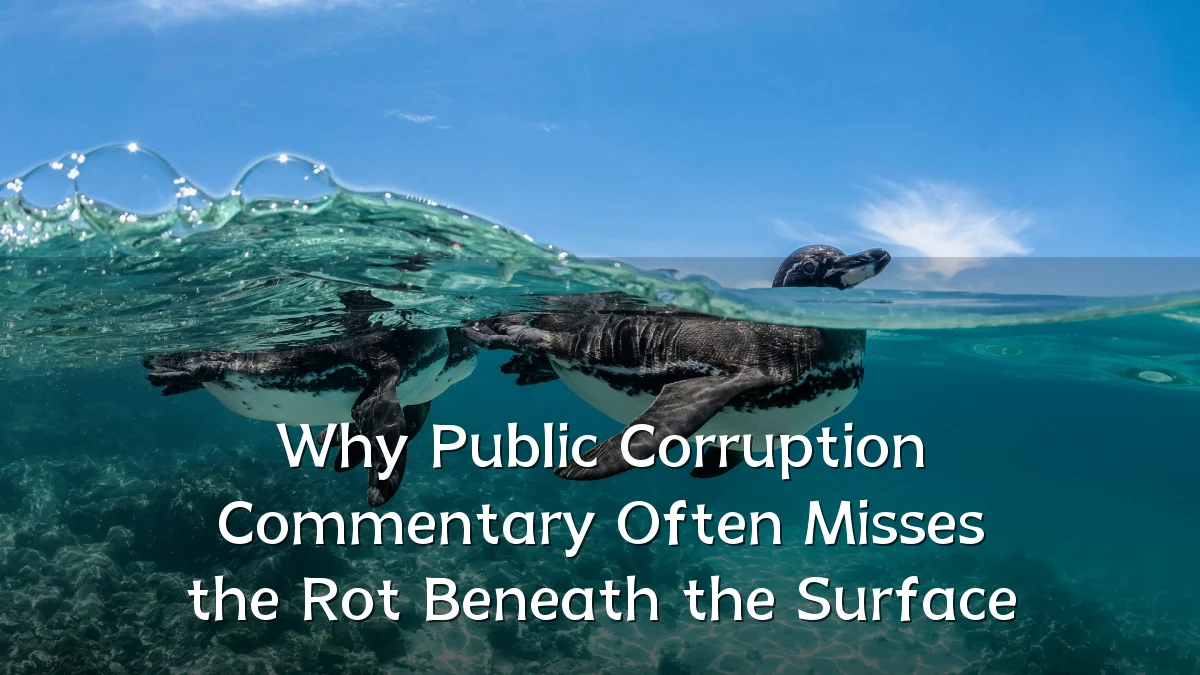
Recent Trends in Commentary Coverage
Public corruption commentary has grown more visible across news analysis, opinion columns, and political talk segments. Yet much of this coverage focuses on individual scandals, criminal charges, or dramatic resignations rather than the structural conditions that allow misconduct to persist. Observers note a recurring pattern: commentary tends to spike after a high-profile investigation or prosecution, then fades once the news cycle shifts.

Analysts point to several tendencies in recent coverage:
- Emphasis on personal wrongdoing over institutional failures
- Heavy reliance on official statements and court documents without deep investigative follow-up
- Framing corruption as a problem of "bad actors" rather than systemic incentives
- Limited attention to the routine, low-level abuses that erode trust over time
Background: Why Surface-Level Analysis Dominates
The gap between public corruption commentary and the underlying reality is not accidental. Newsroom resource constraints, the pace of the 24-hour news cycle, and the legal risks of naming uncharged individuals all push coverage toward the most visible and legally safe targets. Commentators often rely on formal indictments or watchdog reports, which describe symptoms but rarely map the full network of relationships that enable corruption.

Another factor is the incentive structure of commentary itself. Outlets reward swift, decisive takes that fit familiar narratives—greed, cover-up, or political vendetta. Nuanced explanations involving complex procurement rules, weak oversight mechanisms, or diffuse accountability tend to be harder to summarize and less likely to attract engagement.
That leaves a persistent blind spot: corruption that is legal, normalized, or distributed across many hands rarely receives the same scrutiny as a single bribery scheme. This includes revolving-door hiring, favorable contract specifications, donor-aligned policy decisions, and weak recusal practices.
User Concerns: What the Public Notices
Readers and citizens often express frustration that commentary fails to connect isolated incidents to broader patterns. Common concerns include:
- Why the same institutions produce repeat scandals with little structural change
- Why accountability tends to fall on lower-level operatives rather than decision-makers
- Why partisan framing dominates coverage instead of administrative or ethical analysis
- Why commentary rarely explains what a healthy anti-corruption system looks like
Many also observe that coverage can become moralistic without being informative, treating corruption as a character flaw rather than a function of unchecked discretion and weak transparency. That approach may satisfy an audience's desire for outrage but leaves little room for understanding how oversight could genuinely improve.
Likely Impact: Consequences of Shallow Commentary
When commentary consistently misses the structural dimension of corruption, several consequences follow. Public trust in institutions may decline further, not because citizens learn more about systemic risks, but because they see corruption as pervasive and irreparable. Coverage that reduces every scandal to individual guilt can also create a false sense that removing one official solves the problem.
For policymakers, the pressure generated by surface-level commentary tends to produce symbolic reforms—new ethics pledges, reorganized oversight committees, or one-time investigations—while deeper issues such as campaign finance incentives, procurement transparency, and enforcement funding remain underaddressed.
There is also a chilling effect on whistleblowers and internal reformers. When commentary focuses narrowly on prosecutions and public shaming, those who might raise early concerns about questionable practices may hesitate to come forward, fearing the personal cost of becoming a story themselves.
What to Watch Next
Signs of change may come from several directions. Local investigative outlets and nonprofit newsrooms are increasingly pairing traditional reporting with data analysis, sometimes revealing corruption patterns that national commentary overlooks. Academic researchers are also producing more rigorous work on the link between institutional design and misconduct, which may gradually influence how commentators frame their analysis.
Readers should watch for:
- Whether major outlets begin hiring specialists in public administration, procurement, or ethics law
- Whether commentary moves beyond single-scandal coverage to compare patterns across agencies and jurisdictions
- Whether watchdog groups broaden their public reporting to include legal but ethically dubious practices
- Whether new transparency tools make it easier for journalists to trace conflicts of interest and hidden relationships
The most telling shift will be whether coverage starts treating corruption as a system failure rather than a lone offender. Until commentary adopts that perspective, it will continue to describe the surface while the rot beneath remains largely unexplored.